Humans do not always act in a certain way. We can be very rational when faced with an important choice, yet still let our emotions lead the way in other matters. We may crave freedom, while simultaneously understanding that our own principles must also be upheld.
These things are sometimes seen as contradictory. But does balance necessarily come from choosing one side and eliminating the rest?

THE CHRYSANTHEMUM AND THE SWORD
The initial inspiration for Chrysaber comes from the book The Chrysanthemum and the Sword by Ruth Benedict.
In its very name, the sword and the chrysanthemum create a distinct contrast. One side is sharp and rigid; the other is soft and elegant. But upon delving deeper into their cultural significance, those differences are no longer simply an opposition between strength and weakness.
The sword is associated with the image of the Samurai and the Japanese bushido spirit, where loyalty, honor, discipline, and courage are held in high regard.
From HELIOS's perspective, the sword also suggests rationality and decisiveness. A sword does not always signify aggression. Sometimes, it represents the ability to establish boundaries, uphold principles, or make a choice.
Meanwhile, the chrysanthemum bears a completely different form. The slender, layered petals create a soft and delicate appearance. With Chrysaber, HELIOS chooses the chrysanthemum to speak about emotional depth, empathy, and the softer side of human nature.
If the sword suggests decisiveness, the chrysanthemum offers a different perspective: not every situation needs to be resolved with rigidity.
It is this intersection that became the foundation for HELIOS to develop the Chrysaber story.
The sword and the chrysanthemum, two opposing poles that are perfectly balanced. The sword is sharp, rational, and decisive. The chrysanthemum is soft, profound, and emotional.

BALANCE DOES NOT COME FROM ELIMINATION
When talking about balance, the image that usually comes to mind is two sides of equal weight. But in life, balance is not always that simple.
There are decisions that require putting reason first. There are also times when emotions help us see what rigid principles might overlook. A person can be firm in their views yet still be ready to listen to others. One can be serious about set goals but also know how to adapt when circumstances change.
These states do not necessarily negate one another.
Instead of choosing between the sword and the chrysanthemum, HELIOS places them both within the same symbol.
No image is considered more correct, nor does one part need to be eliminated for the other to stand out.
Because in reality, seemingly opposite characteristics can coexist within a single person. What makes the difference sometimes lies not in which characteristics one possesses, but in how one understands and uses them in each situation.
The sword and the chrysanthemum, in this way, are no longer two figures standing on opposite sides. They become different parts of the same story.

FROM TWO SYMBOLS TO THE CHRYSABER CRAFTING LANGUAGE
The Chrysaber story does not stop at a conceptual level.
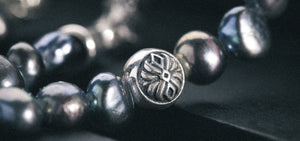
HELIOS brings the sword and the chrysanthemum into handcrafted silver jewelry designs so that these two symbols can be present as concrete lines and details.
The sword blade has a sharp form, while the petals feature soft contours. Each symbol bears its own distinct design characteristic, yet they all belong to the collection's shared design language. On S925 silver, these details are meticulously finished by Vietnamese artisans.
Chrysaber is not limited to a fixed product shape.
From existing designs like the Cala Chrysaber Bracelet to new creations like the Elafo Chrysaber Cuff and Jara Chrysaber Ring, the sword and chrysanthemum symbols continue to be integrated into various forms.
Each design has its own structure and way of being worn, yet it retains a connection to the collection's overarching narrative.
That is also why Chrysaber can continue to develop new pieces without needing to change its original meaning.
WHEN BALANCE BECOMES A WAY OF VIEWING FREEDOM
Freedom is often associated with not being constrained by rules or expectations. But in reality, freedom and principles are not always in conflict.
There are limits set to protect what is important. There are choices that require discipline for a desire to become reality. Similarly, reason and emotion do not necessarily have to compete to decide which is the "right" part of a person. They can complement each other, even if reconciling them is not always easy.
Chrysaber does not offer a formula for achieving balance. The collection also does not try to define what a strong or free person is. Through the imagery of the sword and the chrysanthemum, HELIOS only wishes to offer a perspective: the differing parts within each person do not necessarily have to exclude one another.
Perhaps freedom begins there too. From understanding what we value, recognizing the contradictions that exist, and having the right to choose a way of life that suits ourselves. We do not always need to choose between rigidity and softness; sometimes, there is a place for both.
And that is the story that Chrysaber continues to tell through every creation.