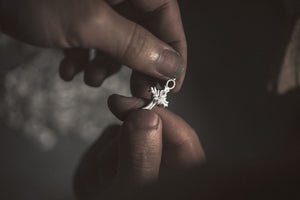
When personal taste becomes more refined, each piece of jewelry becomes a sign of intentional choice.
It's not about how many pieces you wear. It's about which pieces truly resonate with you, aligning with your rhythm of life, current state, and how you wish to present yourself to the world.
There are years when people are easily attracted to prominence.
The bigger, bolder, and more unique a piece is, the more it creates a feeling of individuality. The more layered, detailed, and accentuated an outfit is, the more it draws attention. This is not wrong. It can be a necessary phase, when people experiment more to understand what suits them.
But after many trials, taste often changes.
People choose less based on what's popular, what makes them instantly different, or for the novelty of a few days. Instead, they start looking closer: does this piece truly suit me, does it carry the story I want to express? That's when restraint begins to appear.
Restraint is not about discarding all personality. Restraint is about not letting personality be diluted by too many superfluous details.
One right accent can still be enough.

There's a misunderstanding about minimalism: less is safer, less is less likely to be wrong.
But with jewelry, wearing less doesn't necessarily mean choosing safe. On the contrary, when the number of worn items decreases, each remaining piece bears more weight.
If you only wear one ring, that ring must be just right.
If you only wear one pendant, its symbol must have a sufficient reason.
Less makes choices clearer.

A piece that suits your taste doesn't necessarily have to be the only one.
A person can have many rings, pendants, bracelets, and silver pieces collected over different periods. Each piece comes from a different time, a different story, a different state of the wearer. Some pieces suit days when neatness is needed. Some are for times when a stronger impression is desired. Some go with work. Some are only suitable for trips, private meetings, or a very specific period in life.
The issue is not the quantity. It lies in the reason behind each choice.
When personal taste becomes more refined, people don't necessarily buy less, wear less, or narrow their world. They simply no longer choose unconsciously. Each added piece needs to have its own place: suitable for the body, suitable for the circumstance, suitable for the spirit, suitable for a part of the story that the wearer wants to preserve.
And when superfluous choices are filtered out, each remaining piece, whether a ring, a pendant, a bracelet, or a pair of earrings, becomes weighty.

Intentional choices begin with understanding oneself.
A piece of jewelry shouldn't just be chosen because it's beautiful. Beauty is the first thing. But it's not enough.
Choosing more carefully means looking through more layers. And the truly accompanying item carries a story that resonates with the wearer.
Don't just look at the item. Look at the item on your body.
Don't just look at the details. Look at the details in your rhythm of life.
That is the difference between choosing to add an item and choosing to keep a symbol.
A mature man doesn't necessarily have to over-explain what he wears. But his choices usually have a reason. Sometimes it's a symbol that touches him. Sometimes it's a material he trusts. Sometimes it's a silver piece that has been with him long enough to become a familiar part of him.
Intentional choices don't need to be spoken. They are expressed by the item being in the right place, on the right person, in the right state.