There are symbols that appear in a season, are frequently mentioned, and then gradually disappear. But there are also symbols that never leave. Not because they are repeated long enough, but because over time, the wearer has found a part of themselves in them.

Why can an image stay with a person for so long?
Humans always try to name the things deep within themselves. But not every emotion is easy to put into words, nor does every choice need to be explained. Some beliefs only become clear when given a concrete form.
Symbols do that work. They don't tell the whole story, they just open up a space for the wearer to place their own experiences within. One person looks at the Lotus and sees serenity; another remembers the ability to maintain oneself after a chaotic period. Some choose the Sunflower for always turning towards the light; others keep it because they have been through a long enough dark period to understand that light is not a given, but a direction that must be actively chosen.
The form of a symbol may not change, but its meaning will continue to evolve with each person. This openness allows an image to live longer than a trend: clear enough to have an identity, but not confining the wearer to a fixed definition.

Lotus - Remaining calm amidst chaos
The lotus flower is often referred to as a symbol of tranquility, but tranquility does not mean immobility. To navigate chaos without being swept away, a person needs more strength than a calm exterior might suggest. In the HELIOS world, the Lotus does not just speak of the beauty of a flower; it represents the ability to maintain one's inner structure when everything around is still in motion. A person might choose the Lotus when they need to find peace, and years later, the same symbol might remind them of something else: the time they didn't give up, even when they didn't know how they would emerge from the chaos.
The symbol endures not because its meaning is unchanging, but because the wearer can continue to grow within it.

Sunflower - Turning towards the light, towards the sun, but without ostentation
Sunflowers always turn towards the sun. This image is often understood as a symbol of positivity, but in real life, light is rarely an easy thing.
Not everyone always stands in the light. Some have to go through a very long period before seeing their direction. Some don't move forward with optimistic declarations, but with small choices repeated daily: waking up, continuing work, keeping a promise, and not letting one failure define the rest of their lives.
The Sunflower doesn't say that everything will naturally get better. It reminds us that even when circumstances cannot be changed, one can still choose which way to look. Turning towards the light doesn't mean denying the darkness, but not letting the darkness obscure the path.
A person who chooses the Sunflower might be on a hopeful journey, but it could also be a time when they need a point to aim for. The true meaning of the symbol, therefore, doesn't lie entirely on the surface, but in the reason the wearer decided to carry it.

Chrysaber - A beauty with a backbone
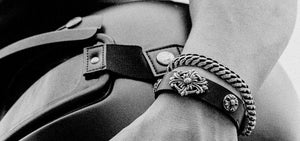
Sword and Chrysanthemum, opposing yet perfectly balanced. The Sword carries strength, honor, and steadfastness, while the Chrysanthemum is noble, pure, and enduring. Like yin and yang, they are the inspiration for the Chrysaber Collection.
There are two extremes within a man, opposing facets that always coexist. They are disciplined, rational, and at the same time, respect emotional values and beauty.
This symbol also embodies the balance between strength and the ability to control that strength. There is sharpness but no chaos, a fighting spirit but not aimed at destroying everything in its path. A blade is only truly meaningful when its wielder knows when to use it and when to sheath it.
Discipline isn't about becoming an emotionless person. It's the ability not to let momentary emotions dictate all actions. Honor also doesn't lie in grand declarations, but in how one maintains principles when breaking them might bring easier benefits.
Some choose to be tall trees reaching for the sky, while others find beauty as a delicate flower hidden in a garden corner.

Tề Thiên - Freedom, defiance, but not meaningless
Freedom is often imagined as a state of no longer being bound. But as one matures, they gradually understand that a life without any limits may not necessarily be freedom; sometimes, it's just a form of disorientation.
The spirit of Tề Thiên embodies defiance and rejection of meaningless frameworks. However, behind that rebellion is not just an instinct to resist, but also the will to define one's own path, accept the consequences, and not give others the power to decide one's life.
Freedom is not merely doing whatever one wants. It's knowing what one wants clearly enough to dare to choose, and then taking responsibility for that choice. Some wear the image of Tề Thiên because they see the power to break limits; some find a part of their ego that was once forced to be silent; others see it as a reminder that not every rule is worth fighting against, but some limits must be overcome to avoid becoming a stranger to oneself.
With the same symbol, each person carries it through a different dialogue with freedom.
Freedom is not about escaping everything; freedom is daring to choose one's own path.
A pair of wings easily makes one think of leaving limits, leaving what holds them back, or leaving a place where they no longer belong. But freedom is not just the ability to leave. Sometimes, freedom is also the right to stay with what one has chosen without changing direction due to external pressure.
Wings don't necessarily mean flying higher than others; they can simply represent the ability to live closer to what one believes.
When on silver, wings are a solid form. When with the wearer, they can become a memory of the first time he dared to leave, decided to start over, or understood that he didn't need to live according to everyone else's perceptions.
Every free choice comes with responsibility, because the moment a person chooses their own path is also when they can no longer fully place responsibility on circumstances.

North Star - Not the brightest, but enough to show the way
Not all lights are born to attract all eyes. Some lights just need to be stable enough for people to know where they are.
The North Star does not represent the need to be the most prominent. It speaks to the ability to maintain direction during times when the path becomes difficult to distinguish. In life, a person does not always need more motivation; sometimes, what is more necessary is an unchanging point: a principle, a promise, or the image of the person one wants to become.
These things do not shorten the path, nor do they eliminate difficulties. But they prevent people from straying too far from what they initially believed to be true. The star does not walk for humans; it only helps them remember where they are going.

HELIOS
The sun doesn't need to speak for people to know it's there; it's recognized by its light, its warmth, and how everything changes as it passes.
A strong enough impression can exist in the same way: not constantly demanding attention, not needing to be explained every time it appears. Its value lies in its ability to be recognized over time, through a language that has become consistent enough to be an identity.
HELIOS Sun is not just the brand name placed on the image of the sun. It also evokes a calm, clear, and unostentatious presence. A man doesn't necessarily have to loudly proclaim his strength or turn every choice into a statement; some qualities only become apparent after others have walked with him long enough: trustworthiness, responsibility, how he keeps his word, and the consistency between what he believes and what he does.
These qualities don't shine for a moment; they are seen over time.

When a common symbol becomes a personal mark
A personal mark is often misunderstood as needing to possess something no one else has: a unique piece, an unprecedented image, or a completely distinct combination. But true uniqueness doesn't necessarily come from being the first to choose that symbol; it lies in how the symbol has lived with a person.
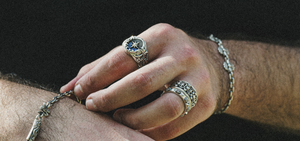
Two people can both wear a Lotus, but over time, as patina touches the product, it takes on a unique mark, because no two people live the same journey; each is an individual. The initial form may be similar, but the journey cannot be duplicated.
HELIOS does the first part, the wearer writes the rest

Some symbols remain not because they are immutable, but because they have witnessed enough change. The wearer is no longer the person they were on day one; how they view love, freedom, strength, and direction is no longer as it was before. But the symbol is still there, not to hold them back in an old version, but to connect different versions along the same journey.
And from there, a common symbol becomes a personal mark.
Perhaps that's why, after many years, people still keep an old piece of silver, not just because of the symbol on it, but because within that symbol lies a part of their own story.