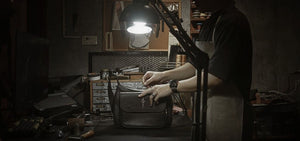
Silver can become tarnished. Leather can soften. Because materials are not static, they have their own movement.
The Movement of Materials
When a piece of jewelry is first completed, everything often appears at its clearest: the silver surface is bright, the lines are sharp, the details are fresh, and the tactile sensation is intact. That is the initial state of the product.
But an item doesn't end the moment it leaves the workshop.
When worn, the material begins a different life. It interacts with skin, with air, with light, with the wearer's daily habits. Each time it's touched, each time it's removed, each time it's set down, each time it embarks on a new journey, it leaves a tiny imprint on the item's surface.
These changes don't appear immediately. But they accumulate.
And eventually, the wearer will realize: the item is still the same design, still the same shape, but the feeling has changed.
Deeper. More familiar. More marked.

Silver Doesn't Just Shine; It Also Tarnishes
With silver, many people often think its value lies in its brightness. A new, shiny, clean silver item can give a polished feel right from the start. But if we only look at silver in its brightest state, we overlook a very important part of this material's life: its ability to change over time.
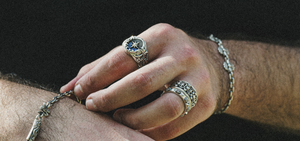
Deep crevices and carved details can darken. The dark-light contrast in silver is what creates the product's depth. A ring with raised details will appear clearer when the background darkens. A pendant with a symbol will have more layers when the silver luster is no longer uniformly flat. A bracelet, after some wear, will feel closer to the wearer than it did on the first day.
That is not stagnation. It is a very slow movement of the material.

Leather Also Has Its Own Way of Moving
If silver moves through light, tone, and surface, then leather moves through softness, fit, and touch.
A new leather bracelet or strap might hold its form more clearly, have a tauter surface, and feel a bit stiffer. But after repeated use, the leather begins to adapt to the wrist, to wearing habits, to body temperature, and to daily movements.
The leather softens. It molds better. It drapes more naturally. Small creases may appear, along with varying shades, and unique marks of the user.
This is what distinguishes leather from many uniformly flat industrial materials. Leather does not remain in a perpetually new state. It lives with the wearer, reacts to use, and gradually takes on a more personal feel.
A leather bracelet worn for many days will no longer be identical to when it was first unboxed. But it is precisely this change that brings it closer to the wearer. It is not just an accessory placed on the wrist, but something that has become accustomed to that wrist's movement.

Patina: Traces of Time on the Silver Surface
In the world of materials, there is a concept very close to this spirit: patina.
Patina can be understood as the layer of marks that forms on the surface of a material after use and exposure to the environment. For silver, patina is not just about an item getting old. It is how the silver surface records the wearer's time, habits, and journey.
A silver item with a patina is not like a neglected silver item. It is a silver item that has been genuinely used.
The difference lies in the feeling. A neglected product might be uniformly dull, lifeless, and uncared for. But a silver item worn regularly will have areas that brighten from contact with the skin, areas that darken in deep crevices, and small scratches from natural bumps.
No two patinas are created alike. Because no two people live with an item in the exact same way.

Care Is Not About Erasing All Traces
A genuinely used item still needs proper care.
But care does not necessarily mean returning the product to its completely new state. Care is about keeping the item with the wearer in the best possible condition: cleaner, more durable, easier to wear, but still retaining some of its unique, developed marks.
For silver, there are times when it should be cleaned to restore its necessary shine. For leather, keeping it dry, avoiding prolonged dampness, and limiting chemical exposure will help the material last longer, but it won't prevent it from softening over time. With natural materials, understanding the characteristics of each material helps the wearer use them more appropriately, rather than expecting them to remain immutable.
Caring for materials is therefore not about fighting time. It is a more responsible way of moving with time.

Materials also have their own movement.
Not as fast as a rotating mechanism. Not as obvious as a detail that can be opened and closed. But slow, persistent, and more real. Silver moves through shades. Leather moves through softness and fit. Natural materials move through grain, luster, surface, and unique marks.
When accompanying the wearer, the material no longer remains in its initial static state. It changes, adapts, records, and becomes more personal through each journey.
A good enough item doesn't just need to look beautiful when new. It needs to be able to live with the wearer, acquire the marks of time, and continue to retain its spirit after many movements.