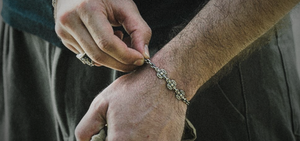
The wrist is constantly in motion. And when silver or leather accompany this rhythm of life, each material leaves a different sensation.
Silver retains its coolness. Leather retains its warmth and softness. One creates weight. The other creates familiarity.
Two materials, two states, but both speak of one thing: an item only truly has meaning when it is worn and lives with the wearer.

The closest place
Some pieces of jewelry are mainly seen. But a bracelet is something that is both seen and felt almost constantly.
The wearer can feel the weight of the bracelet. Its snugness around the wrist. The sensation of the material touching the skin. The change as the wrist moves. The way the bracelet lightly brushes against a desk, sleeve, or watch. How it rests after a long day.
Therefore, the material of a bracelet is much more important than the initial impression from a photo.
A bracelet that looks beautiful in a picture but is too cumbersome to wear will likely not stay long. A bracelet with a strong design but lacking comfort will hardly become an everyday item. A good material that doesn't suit the wearer's lifestyle will quickly be left in a box.
A bracelet doesn't just need to be beautiful. It needs to match habits. It needs to match the state the wearer wants to carry.

Silver: cool, sharp, and weighty
Silver creates a distinct sensation from the first touch. It has a natural coolness. It has its own sheen. A silver bracelet, whether large or small in design, always brings a feeling of solidity and substance.
Silver is cast, carved, polished, surface-treated, given raised and sunken forms, creating areas of light and shadow. Therefore, the state of silver is quite clear. It doesn't necessarily have to be ostentatious. But when it appears, silver often creates a feeling of certainty, coolness, balance, and weight.

Leather: warm, soft
If silver creates a cool and sharp sensation, leather goes in the opposite direction.
Leather has warmth. It has softness. It feels closer to the body. A leather bracelet doesn't shine as brightly as silver, but it creates a more subdued, lived-in feel. It doesn't necessarily make the wrist the first focal point, but it makes the overall look feel natural and easy to live with.
Leather is also a material that changes very clearly over time.
When new, a leather bracelet may hold its shape better, its surface still taut, and feel new when worn. But after many uses, the leather begins to soften. Small creases appear. Areas become lighter or darker. It conforms more naturally. The material gradually adapts to the wearer, rather than just resting on the wrist like a foreign object.
This is what gives leather its unique feel.
It doesn't need to maintain its original state to be valuable. On the contrary, the more a leather bracelet is used, the more it feels like it belongs to the wearer. Not in an overly obvious way, but through small changes: more softness, better fit, a more textured surface.
The state of leather is one of familiarity.

Two materials, two ways of speaking
Silver and leather are not only different in their surface. They create two different ways of being present.
Silver suits those who want a clearer mark. Not necessarily loud, but with substance. Silver creates a sense of structure, form, and meticulousness in detail. A silver bracelet on the wrist can make the wearer look sharper, more decisive, more grounded.
Leather suits those who want a more subdued feeling. Closer. More real. Leather doesn't try to draw attention with brightness, but creates a feeling of durability, familiarity, and less ostentation. A leather bracelet on the wrist can make the overall look less cold, less rigid, adding warmth and naturalness.
And when silver is combined with leather, it's a very masculine combination.
No material is "more correct" than another. There is only the state that is more correct for the wearer at that moment.

Silver and leather on the wrist are two materials, two states.
Silver darkens over time, leather softens with every wear.