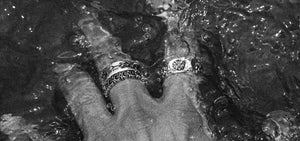
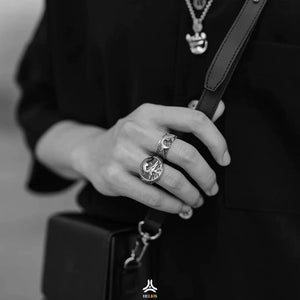
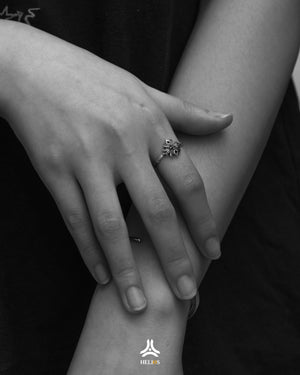
A small scratch on the silver surface. A darkened area in a deep crevice after days of companionship. These changes do not diminish the ring's value. On the contrary, they give the item a life of its own.

The movement of silver
It's no coincidence that rings are always one of the most meaningful pieces of jewelry.
Hands are always moving. Therefore, a ring is not just worn. It participates in almost every aspect of the wearer's daily life. It bumps against a table. Touches a pocket. Rubs against a sleeve. Passes through water, sweat, dust, light, air, and the very personal habits of each individual.
For this reason, rings are the silver items most likely to show the marks of time.
A necklace can lie still under clothing. An earring can move with the face. A bracelet follows the wrist. But a ring is different. A ring is in the place of most direct contact with life.
It accompanies action. And action always leaves a trace.

Scratches
When buying jewelry, many people often want to keep their silver items very new, very bright, very clean. This is not wrong. A well-cared-for item will last longer, be easier to wear, and maintain its neat appearance for longer.
But if we only see every scratch as something to be erased, we will overlook a very important part of the life of a silver ring.
Scratches are a sign that the item has truly been used.
A ring that stays in its box can remain new for a very long time. But it has no journey. No bumps. No traces of the wearer. It is beautiful in a static state, but it has not truly entered life.
A ring worn every day is different. It may no longer be as perfect as it once was, but it gains a sense of belonging. The small marks on the surface do not weaken the ring's spirit. On the contrary, they make the item more personal.
The most beautiful marks are not those created for decoration.
The most beautiful marks are those that form after a long enough time, when the item has truly accompanied the wearer.

Patina: when time adds depth to silver
With silver, the marks of time are not only in scratches. They are also in the patination that forms on the surface of the material after use and exposure to the environment.
The recessed areas can darken, making the design lines clearer and more profound. With rings that have shapes, symbols, or engraved details, patina sometimes makes the product more soulful than when it was brand new.
A new ring shows craftsmanship. A ring that has been worn for a long time shows something else: how the wearer lives with it.
That's why patina shouldn't just be understood as "silver getting old." Patina is how silver records time. It doesn't replace the original finishing standard but adds a layer of life that no design can pre-create.
A ring with patina is not necessarily for everyone. Some people prefer silver to always be bright. Others prefer a more subdued, aged, marked feel. But for HELIOS, both choices can be right, as long as the wearer understands what they are choosing.

Hands create movement. Rings accompany that movement. Time passes through both, leaving its unique marks on the silver surface.
A new ring can show its design.
A well-worn ring shows its journey.
A ring with marks has begun to live.
A truly weighty piece of silver is not just about its weight when held. Its weight also lies in the time it has accompanied the wearer, in the unique small scratches, in the slowly forming patina, and in the sense of belonging that only the wearer truly understands.
You just need to choose correctly, and time will do the rest.